- In most job shops, the estimator, not the machines, limits how many RFQs you can quote.
- An agent reads the RFQ and drawing, finds similar past jobs and pre-fills material, operations and time ranges. Your estimator sets price, margin and lead time.
- Drawings marked CUI or covered by ITAR need a government-approved environment, such as Claude on Amazon Bedrock in AWS GovCloud (US).
- Softpers starts with a fixed-price pilot that quotes 50 finished jobs where you already know the actual cost.
- Builds start from $3k. You see a first working version in 1–2 weeks during the fixed-price pilot, and a quoting agent for one shop's RFQ inbox typically goes live in 2–8 weeks.
Your estimator, not your machines, sets how much work you can win. Every RFQ waits for the same one or two people who know your rates, your machines and the parts you've run before. In a July 2025 survey of 200 US manufacturers, wholesalers and distributors, run by TrendCandy for quoting-software maker Aleran, 88% reported lost deals and said manual sales and quoting processes cost them an average of 5% of revenue a year (Aleran, 2025). Check your own number: pull last quarter's RFQs and count the days from receipt to quote sent. This guide shows where an agent fits, what your estimator still decides, how controlled drawings change the setup, and what it costs.
Why quotes back up in a job shop
A typical RFQ is an email with a PDF drawing, a STEP file, a spec sheet and sometimes a list of required certifications. Before anyone can price it, someone has to work out:
- the material and stock size
- the operations: saw, mill, turn, deburr, inspect
- outside processing such as anodizing, plating or heat treat
- setup and cycle time, often from memory
Three things slow this down. The estimator is also the programmer or shop lead, so quotes wait for a gap in the day. Repeat and similar parts get estimated from scratch, because finding the old job in the ERP takes longer than starting over. And no-quote decisions come late: an RFQ with a tolerance or material you can't hold sits in the queue for days before anyone says no.
Controlled drawings: ITAR, CUI and CMMC
DFARS 252.204-7012 requires systems holding covered defense information to meet NIST SP 800-171, and any cloud provider storing it to meet the FedRAMP Moderate baseline or equivalent (DFARS 252.204-7012). Under ITAR, technical data includes blueprints and drawings for defense articles (22 CFR 120.33).
| Drawing | Rule | Where the agent can run |
|---|---|---|
| Commercial, no markings | Your NDA with the customer | The standard Claude API |
| Marked CUI, from a defense contract | DFARS 252.204-7012 and NIST SP 800-171 | A FedRAMP-equivalent environment, such as Claude on Amazon Bedrock in AWS GovCloud (US), which Anthropic says is approved for FedRAMP High workloads (Anthropic, 2025) |
| ITAR technical data | 22 CFR 120.33 | The same environment, with access set by your export compliance lead |
CMMC Phase 2, which would have required third-party assessments in many contracts from November 10, 2026, was suspended on July 13, 2026. DFARS 252.204-7012 and the Level 1 and Level 2 self-assessments still apply (Crowell & Moring, 2026). A September 3, 2026 class deviation told contracting officers to remove third-party assessment requirements from contracts (Washington Technology, 2026). None of this is legal advice. Check your contracts with your compliance lead.
What the agent fills in, and what your estimator decides
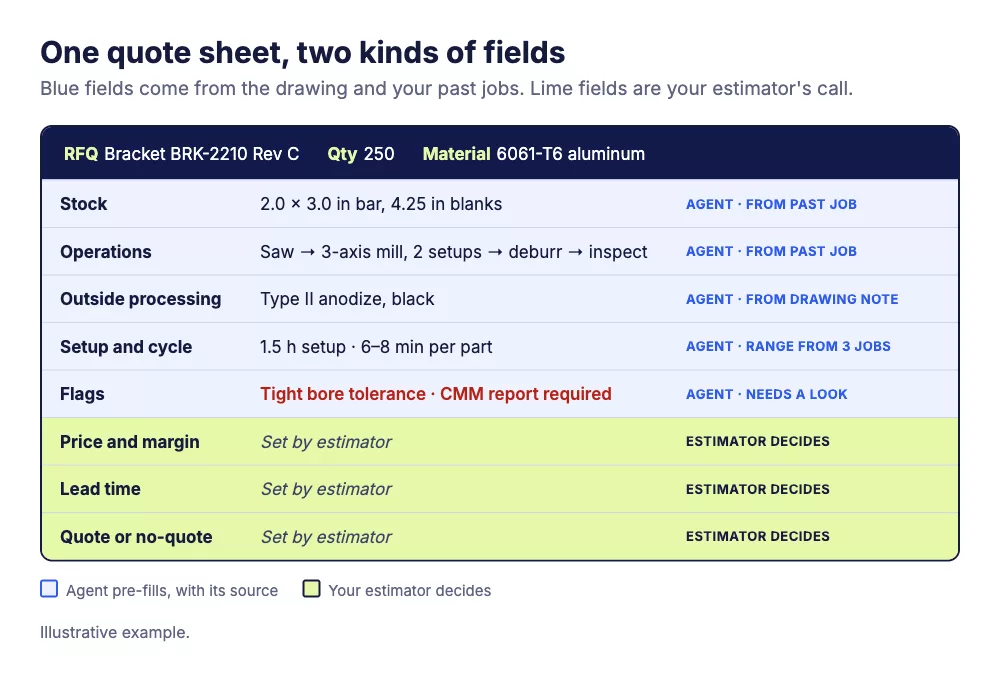
- Read the RFQ packagePulls part number, revision, quantity, material, finish, tolerances and required certs from the email, drawing and spec sheet.
- Find similar past jobsSearches your ERP for the same or similar parts and shows what you quoted and what the job actually took.
- Pre-fill the estimateDrafts material, operations, outside processing and setup and cycle time ranges, each linked to the job it came from.
- Flag what's missing or riskyLists unclear callouts, tight tolerances, missing finish specs and certs you don't hold.
- Your estimator prices itChecks the draft, then sets price, margin and lead time, or marks it no-quote.
AI can misread a callout on a crowded drawing, so every number passes your estimator. It's the same split as in our guide to AI takeoff for commercial GCs: the software does the reading, a person owns the number. Scrap and rework from your corrective action records can also flag repeat parts that should be quoted higher.
Quoting software or a custom agent?
Paperless Parts says its Wingman AI reads prints, flags specifications such as ASTM, MIL-SPEC and GD&T callouts, and processes forwarded RFQ emails (Paperless Parts, checked November 2026). It says the platform is hosted on AWS US GovCloud, is ITAR registered and is "CMMC Level 2 Assessment-Ready" (Paperless Parts, checked November 2026). Neither page publishes prices.
| Quoting platform | Custom agent | |
|---|---|---|
| Where quoting happens | The vendor's platform | Your ERP and inbox |
| Past-job data | What you load into it | Your full ERP history, read in place |
| Rules | The vendor's settings | Your rates, no-quote rules and customer terms |
| Controlled drawings | The vendor's hosting | Your approved environment |
| Ownership | Subscription | You own the code |
How Softpers builds a quoting agent
- Free 30-minute callYou show us a few recent RFQs and your ERP. We send an estimate within 24 hours.
- Fixed-price pilot, 1–2 weeksThe agent drafts estimates for 50 finished jobs. You compare its hours with what you quoted and what the jobs actually took.
- Connect and add guardrailsWe connect your inbox and ERP, set no-quote rules and approval steps, and demo progress every week.
- Launch and trainDrafts appear for every new RFQ, with runbooks for your estimators.
- 30-day warrantyWe watch it closely and fix issues. Then it's fully yours.
| System | What the agent reads | How it connects |
|---|---|---|
| RFQ inbox | Emails, PDFs, STEP files, specs | Your email provider's API |
| ERP (JobBOSS², E2, ProShop, Epicor, Global Shop) | Past quotes, routings, actual hours | API or scheduled exports |
| Rates and materials | Machine rates, material prices, vendor quotes | Your ERP or price sheets |
| Document control | Certs and approved specs | Read-only access |
When a quote is won, the purchase order lands in the same inbox, and AI order entry can key it into the ERP.
What a quoting agent costs
Softpers projects start from $3k. You see a first working version in 1–2 weeks during the fixed-price pilot, and a quoting agent for one shop's RFQ inbox typically goes live in 2–8 weeks, with a 30-day warranty (Softpers AI Agents, checked November 2026). Running controlled drawings in a government cloud adds setup work, so it shows up in the estimate.
One RFQ uses roughly 30,000 input tokens (the email, a four-page drawing, spec excerpts and ten similar past jobs) and 2,000 output tokens. At Claude Sonnet 5.5's $2 and $10 per million on Anthropic's API (Anthropic, checked November 2026), that's about 8 cents. Check Amazon Bedrock pricing if controlled drawings run there.
Here's an illustrative example, not a client result. A shop gets 80 RFQs a month. Estimating each takes 60 minutes by hand and 25 minutes when the agent has pre-filled it. That saves about 47 hours a month, about $1,735 at the $37.17 mean hourly wage for cost estimators at machine shops (BLS, May 2025), or about $20,800 a year before benefits. AI usage is under $10 a month. The bigger gain is the RFQs you can now answer the same day.
Is a quoting agent right for your shop? 30 seconds
FAQs
Can AI read our drawings and GD&T?
It reads most title blocks, notes, materials and callouts well, and it flags what it isn't sure about. Dense drawings, faint scans and complex GD&T can be misread, so your estimator checks every value before it's priced.
Will it set our prices?
No. It drafts material, operations and time ranges from your own job history. Your estimator sets the price, margin and lead time, and decides whether to quote.
Can it handle ITAR or CUI drawings?
Yes, if it runs in an environment that meets your contract rules, such as Claude on Amazon Bedrock in AWS GovCloud (US). Commercial drawings can use the standard API. Your compliance lead decides which RFQs go where.
Which ERP does it work with?
Any job shop ERP we can read through an API or regular exports, such as JobBOSS², E2, ProShop, Epicor or Global Shop. We confirm access during the free call.
How long until it's live?
You see a first working version in 1 to 2 weeks during the fixed-price pilot, and a quoting agent for one shop's RFQ inbox typically goes live in 2 to 8 weeks.
- B2B manufacturing survey: manual quoting processes leading to lost revenue (Aleran press release, survey by TrendCandy, July 2025)
- DFARS 252.204-7012: Safeguarding Covered Defense Information and Cyber Incident Reporting (Acquisition.gov)
- 22 CFR 120.33: Technical data (Legal Information Institute)
- Claude in Amazon Bedrock approved for FedRAMP High and DoD IL4/5 (Anthropic, June 2025)
- Department of War immediately suspends CMMC Phase II requirements (Crowell & Moring, July 2026)
- CMMC's Phase 2 suspension locked in with binding regulation (Washington Technology, September 2026)
- Paperless Parts Wingman (Paperless Parts, checked November 2026)
- Security (Paperless Parts, checked November 2026)
- Claude API pricing (Anthropic, checked November 2026)
- Occupational Employment and Wage Statistics: Machine Shops; Turned Product; and Screw, Nut, and Bolt Manufacturing, May 2025 (U.S. Bureau of Labor Statistics, 2026)
- AI Agents service (Softpers, checked November 2026)

Haider AbbasSoftware Engineer of Softpers
Full-Stack Software Developer with 5+ years of experience building scalable web applications using Laravel, React.js, Next.js, Node.js, Python, and Django. Passionate about problem-solving, clean architecture, AI-powered solutions, and delivering high-quality software that drives business value.