- Auditors expect problems. What they write up is a corrective action closed without a confirmed root cause or proof that the fix worked.
- In IAOB data reported in August 2026, problem solving (clause 10.2.3) was the most common major nonconformity in IATF 16949 audits.
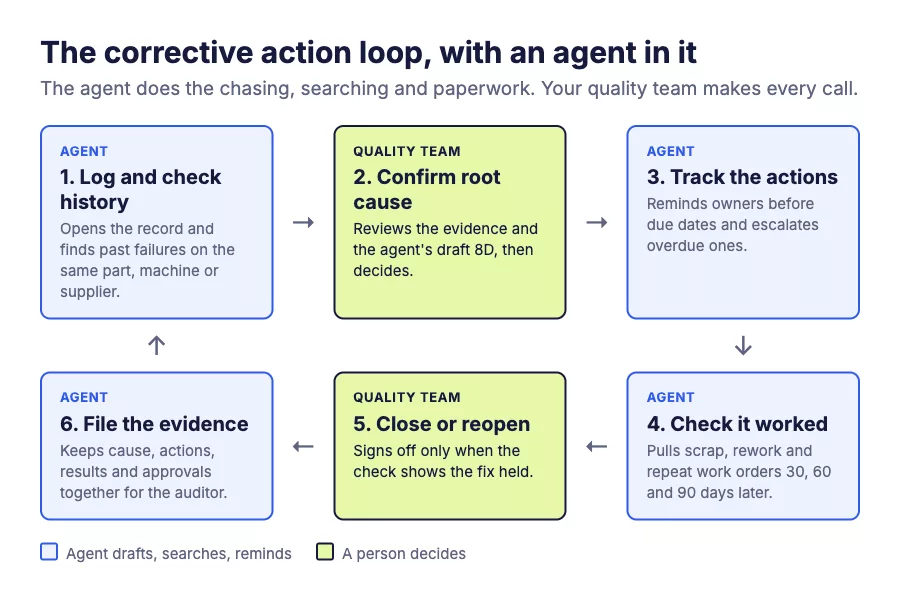
- An agent finds repeat failures, drafts the 8D, chases owners, checks the fix held and builds the audit pack. Your quality team makes every decision.
- Softpers starts with a fixed-price pilot on last year's corrective actions, then connects your log, CMMS and ERP, with every action logged.
- Builds start from $3k. You see a first working version in 1–2 weeks during the fixed-price pilot, and an agent for one plant's corrective actions typically goes live in 2–8 weeks.
Auditors expect you to have problems. What they write up is what you did about them. In IAOB data summarized by the certification body Amtivo in August 2026, problem solving (clause 10.2.3) was the most common major nonconformity in IATF 16949 audits, and nonconformity and corrective action (10.2.1) was third (Amtivo, 2026). Behind both is the same pattern: actions closed without a confirmed root cause, or without checking that the fix worked. This guide is for US plants. It shows where an agent fits in that loop, what your quality team still decides, how Softpers builds it and what it costs.
Why corrective actions run late
A nonconformance gets raised after a customer complaint, an internal audit or a spike in scrap. Containment happens fast. Then the record waits, because the quality engineer who owns the 8D is also running first-article inspections and answering customer calls.
The evidence lives in different places. The nonconformance sits in a quality system or a spreadsheet, the repair in the CMMS, the retraining record with HR and the revised work instruction in document control. Pulling one record together can take an afternoon.
Three things go wrong as a result:
- Root causes get written as "operator error" because there's no time to dig further.
- Actions get closed when the work is done, not when the fix is shown to hold.
- The same failure comes back on another shift and gets a new record instead of reopening the old one.
What auditors check under ISO 9001 and IATF 16949
ISO 9001's clause 10.2 asks you to react to a nonconformity, evaluate whether action is needed to remove its cause and whether similar problems exist elsewhere, carry out the action, review whether it worked, and keep records of the nonconformity, the actions and the results. That's how Auditor Training Online (2023) summarizes the 2015 edition.
| Requirement | What the auditor asks for | Where it often lives |
|---|---|---|
| React and contain | Containment date, suspect stock held | Quality system or spreadsheet |
| Find the cause | Root cause analysis, such as 5 Whys or an 8D | 8D form, email threads |
| Look for similar problems | A check of other lines, parts or plants | Often skipped |
| Fix it | Actions, owners and completion dates | Quality system, CMMS work orders |
| Prove it worked | Scrap, rework or repeat failures after the fix | ERP, MES or a spreadsheet |
The standard has a new edition. ISO 9001:2026 was published on September 16, 2026, and certified companies have until September 30, 2029 to transition (LRQA, 2026). Check clause numbers against the edition you're audited to.
Automotive suppliers also work to IATF 16949, the automotive quality standard, which the IATF keeps aligned with ISO 9001. It adds its own problem-solving clause, 10.2.3, the clause cited most often in the IAOB data above.
Five jobs an agent can take off your quality team
| Job | What the agent does | Who decides |
|---|---|---|
| Find repeats | Searches past nonconformances and work orders for the same part, machine, supplier or defect code, and links them | An engineer decides whether to reopen an old action |
| Draft the 8D | Fills in the problem description and timeline from the records, and lists candidate causes with the evidence for each | The team confirms the root cause |
| Chase owners | Reminds action owners before due dates and escalates overdue actions | The quality manager agrees any extension |
| Check it worked | Pulls scrap, rework and repeat work orders 30, 60 and 90 days after the fix, and flags any rise | An engineer closes or reopens the action |
| Build the audit pack | Collects cause, actions, completion evidence, results and approvals for each action into one file | The quality manager reviews it before the audit |
The repeat search is often where the value shows up first. A failure logged as three separate nonconformances on three shifts becomes one problem with three data points, and that makes the root cause easier to find.
When the agent isn't sure two records are the same failure, it flags them for a person, the same rule we use for AI order entry at distributors. Containment, disposition of suspect product and any 8D sent to a customer stay with your team.
Built-in QMS AI or a custom agent?
Quality software vendors are adding AI. ComplianceQuest's Summer '26 release, generally available on July 31, 2026, added an Investigation Assistant that suggests root causes, containment actions and corrective action plans from past investigation records and FMEA data, with people reviewing the output (ComplianceQuest, August 2026). The release doesn't give pricing. CMMS vendors are doing the same inside their own products: MaintainX's AI page lists troubleshooting help drawn from manuals and work history (MaintainX, checked November 2026).
| Built-in QMS AI | Custom agent | |
|---|---|---|
| Where it works | Records inside that QMS | Across your QMS or spreadsheet, CMMS, ERP and documents |
| What you need first | That QMS, on a plan that includes the AI | The systems you already use |
| Report format | The product's investigation forms | Your 8D, A3 or customer-specific template |
| Setup | Configure the module | First working version in 1–2 weeks (fixed-price pilot), live in 2–8 weeks |
| Ownership | Part of the subscription | You own the code |
Our guide to KYC and KYB automation works through the same buy-or-build choice for another audited process, FinTech onboarding.
How Softpers builds a CAPA agent
- Free 30-minute callYou walk us through your corrective action log and CMMS. We send an estimate within 24 hours.
- Fixed-price pilot, 1–2 weeksThe agent reads 12 months of exports and lists overdue actions, likely repeats and actions closed without an effectiveness check. Your engineers confirm or reject each flag, so you see its accuracy on your data.
- Connect and add guardrailsWe connect your systems, set who approves each step and show progress in a demo every week.
- Launch and trainDrafts, reminders and effectiveness checks go live for new nonconformances, with runbooks for your team.
- 30-day warrantyWe watch it closely and fix issues. Then it's fully yours.
| System | What the agent reads | How it connects |
|---|---|---|
| Corrective action log | Actions, owners, due dates, causes | Your quality system's API, or the spreadsheet itself |
| CMMS | Work order history by asset | The vendor's API: MaintainX, UpKeep (Enterprise plan) or Fiix |
| ERP or MES | Scrap and rework by part | A scheduled report export |
| Document control | Current work instruction revisions | Read-only access |
Part numbers, asset IDs and defect codes have to match across these systems, or the repeat search misses links. We start with your 20 most common defect codes. Your data stays in your own accounts.
What a CAPA agent costs
Softpers projects start from $3k. You see a first working version in 1–2 weeks during the fixed-price pilot, and an agent for one plant's corrective actions typically goes live in 2–8 weeks, with a 30-day warranty (Softpers AI Agents, checked November 2026). Each extra system to connect, such as a second plant's CMMS, adds build time, so it shows up in the estimate.
One draft uses roughly 40,000 input tokens (the finding, about 20 related records and the work instruction) and 3,000 output tokens. At Claude Sonnet 5.5's $2 and $10 per million (Anthropic, checked November 2026), that's about 11 cents. Our dental insurance verification playbook shows the same per-item math for another back-office task.
Here's an illustrative example, not a client result. A plant raises 20 corrective actions a month. Writing each up takes 90 minutes; reviewing a draft takes 30. Chasing owners drops from 8 hours a month to 2. That's 26 hours a month, about $665 at the $25.58 mean hourly wage for inspectors in fabricated metal product manufacturing (BLS, May 2025). Audit preparation drops from 40 hours to 10 before each of three audits a year, worth about $2,300. Total: about $10,300 a year before benefits, not counting a major nonconformity avoided.
Is a corrective action agent right for you? 30 seconds
FAQs
Can AI find the root cause for us?
It can suggest likely causes and show the records behind each one. Your quality team confirms the cause with evidence, because AI can suggest a cause that fits the data and is still wrong.
Will auditors accept corrective action records drafted by AI?
Auditors judge the cause analysis, the actions and the evidence that the fix worked, not who typed the first draft. Every record shows who approved each step and when. If you're unsure, ask your certification body.
Do we need quality management software first?
No. Many plants run corrective actions in a spreadsheet. The agent can work from that log plus exports from your CMMS and ERP.
Does it work with our 8D or A3 template?
Yes. The agent fills in your own template, including customer-specific 8D formats, so records look the same as they do today.
How long until it's live?
You see a first working version in 1 to 2 weeks during the fixed-price pilot, and an agent for one plant's corrective actions typically goes live in 2 to 8 weeks.
- Top 5 major IATF 16949 nonconformities (Amtivo, August 2026, citing IAOB data)
- ISO 9001 Clause 10.2: Nonconformity and Corrective Action (Auditor Training Online, 2023)
- ISO 9001:2026 is live: the transition period has begun (LRQA, September 2026)
- About IATF 16949:2016 (IATF)
- ComplianceQuest Summer '26 expands CQ.AI (ComplianceQuest press release, August 2026)
- MaintainX AI (MaintainX, checked November 2026)
- MaintainX REST API v1 (MaintainX, checked November 2026)
- UpKeep API documentation (UpKeep, checked November 2026)
- Fiix API developer guide (Fiix, checked November 2026)
- Claude API pricing (Anthropic, checked November 2026)
- Occupational Employment and Wage Statistics: Fabricated Metal Product Manufacturing, May 2025 (U.S. Bureau of Labor Statistics, 2026)
- AI Agents service (Softpers, checked November 2026)

Haider AbbasSoftware Engineer of Softpers
Full-Stack Software Developer with 5+ years of experience building scalable web applications using Laravel, React.js, Next.js, Node.js, Python, and Django. Passionate about problem-solving, clean architecture, AI-powered solutions, and delivering high-quality software that drives business value.