- Entry problems often start before filing, when the invoice, packing list, bill of lading and ISF describe the same freight differently.
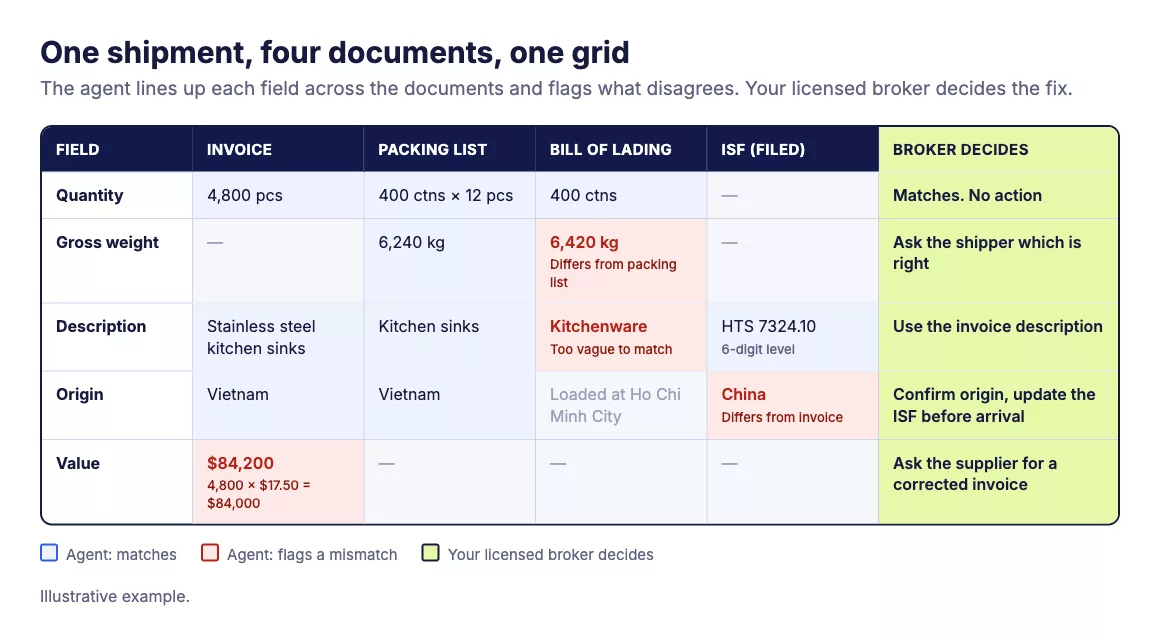
- An AI agent lines up quantity, weight, description, origin and value across every document and flags each mismatch. Your licensed broker decides the fix.
- A missed mismatch can mean $5,000 in ISF liquidated damages or a negligence penalty under 19 U.S.C. 1592, and CBP looks at how brokers supervise the work.
- Softpers starts with a fixed-price pilot that replays about 100 of your past entries against the corrections you actually made.
- Builds start from $3k. You see a first working version in 1–2 weeks during the fixed-price pilot, and an agent for one office's entry desk typically goes live in 2–8 weeks.
Your entry is only as good as the documents behind it, and those documents come from different parties who rarely check each other's work. The volume is also growing. Since August 29, 2025, low-value shipments that used to clear under the $800 de minimis exemption need a formal or informal entry (postal shipments are covered by a separate CBP rule), and CBP processed over 1.36 billion of those shipments in fiscal year 2024 (CBP interim final rule, June 2026). More entries go through the same licensed brokers. This guide shows why documents disagree, what a missed mismatch can cost, how an agent lines the documents up, and what it costs to build.
Why entry documents disagree
A typical ocean shipment lands in your inbox as four or more files. They describe the same freight, but not in the same way:
- Quantity: the invoice counts pieces, the packing list counts cartons, and the bill of lading counts packages.
- Weight: the packing list shows net and gross, and the bill of lading shows a gross weight someone keyed by hand.
- Description: "stainless steel kitchen sinks" on the invoice becomes "kitchenware" on the bill of lading.
- Origin: the factory country, the port of loading and the seller's country are easy to mix up.
Timing adds to it. The ISF's origin and HTS number are due 24 hours before the cargo is loaded at the foreign port (19 CFR 149.2), often before the final invoice exists. Revised invoices arrive by email a week later, and nobody goes back to compare them with what was filed.
What a missed mismatch can cost
| Mismatch | The rule | What can happen |
|---|---|---|
| Origin or HTS number on the ISF differs from the invoice | The ISF must be updated if more accurate information becomes available before the goods enter the limits of a US port (19 CFR 149.2) | Liquidated damages of $5,000 for each violation of the bond's ISF conditions (19 CFR 113.62) |
| Quantity, description or package contents don't match | The invoice must describe the goods, quantities and each package's contents (19 CFR 141.86) | If a material false statement enters through negligence, a penalty of up to the lesser of the goods' domestic value or twice the lost duties, or 20% of dutiable value if duties weren't affected (19 U.S.C. 1592) |
| Errors pass without a broker's review | Responsible supervision and control by licensed brokers (19 CFR 111.28) | CBP may weigh review frequency, reject rates and training when it judges supervision |
Brokers must also check what they tell clients with due diligence and report errors to them promptly (19 CFR 111.39). Clerical errors fall outside Section 1592 unless they form a pattern of negligence. This isn't legal advice; check with your customs counsel. KYC and KYB checks at FinTechs work the same way: software checks the documents and a person makes the call.
How the agent lines up the documents
- Collect the document setGathers the invoice, packing list, bill of lading or air waybill and the filed ISF for one shipment, from email, portals or your entry system.
- Pull the fieldsReads quantity, units, weights, descriptions, origin, value, currency, seller and manufacturer from each document.
- Line them upMatches invoice lines to packing list cartons and checks the totals, unit math and weights across documents.
- Flag what disagreesLists each mismatch or missing field, with the documents it came from and the rule it touches, such as an ISF that needs updating.
- Your broker decidesAsks the shipper for a corrected document, updates the ISF, adjusts the entry data or holds the shipment.
- Hand off clean dataPasses the checked fields to your entry system, where your team writes and transmits the entry as usual.
Reading the documents is the same skill as AI order entry for distributors, where emailed POs become ERP orders. The difference is that here the documents get compared with each other, not just keyed in. Scanned or handwritten pages get flagged for a person instead of guessed.
Built-in customs software AI or a custom agent?
CargoWise says its ComplianceWise feature captures commercial invoice data automatically and returns a high, medium or low risk rating for each commodity (CargoWise, checked November 2026). Descartes says its Image Document Management reads commercial invoices, bills of lading and other trade documents and understands how they relate to one another (Descartes, checked November 2026). Magaya says its Broker AI Assistant extracts data from PDF or spreadsheet invoices into an entry and recommends HTS codes (Magaya, February 2025). None of the three pages publishes prices.
| Built-in AI | Custom agent | |
|---|---|---|
| Works inside | That vendor's platform | Your inbox, portals and entry system |
| Checks | What the vendor built | Your own checks, such as one shipper's usual origin or weight per carton |
| Documents | Varies by product; ask which ones it reads | The full set, including the filed ISF |
| Ownership | Part of your subscription | You own the code |
How Softpers builds an entry-check agent
- Free 30-minute callYou walk us through a few recent shipments and your entry system. We send an estimate within 24 hours.
- Fixed-price pilot, 1–2 weeksThe agent checks about 100 past entries. You compare its flags with the corrections, ISF updates and shipper follow-ups you actually made.
- Connect and add guardrailsWe connect your inbox and entry system, set your checks and approval steps, and demo progress every week.
- Launch and trainEvery new shipment gets a flag list before entry, with runbooks for your team.
- 30-day warrantyWe watch it closely and fix issues. Then it's fully yours.
| System | What the agent reads | How it connects |
|---|---|---|
| Shared inbox and shipper portals | Invoices, packing lists, bills of lading | Your email provider's API or portal downloads |
| Entry system (CargoWise, Descartes, Magaya) | Shipment files and filed ISF data | API or scheduled exports |
| Shipper profiles | Usual origins, parts, weights and HTS numbers | Your entry system or a spreadsheet |
| Audit log | Every flag and who resolved it | Written by the agent, kept for your records |
Clean paperwork is half the job if you also book trucks. The other half is knowing the carrier is real, which our guide to AI carrier vetting for freight brokers covers.
What an entry-check agent costs
Softpers projects start from $3k. You see a first working version in 1–2 weeks during the fixed-price pilot, and an agent for one office's entry desk typically goes live in 2–8 weeks, with a 30-day warranty (Softpers AI Agents, checked November 2026).
One shipment uses roughly 30,000 input tokens (about 12 pages of documents, the filed ISF, the shipper profile and instructions) and 3,000 output tokens. At Claude Sonnet 5.5's $2 and $10 per million tokens on Anthropic's API (Anthropic, checked November 2026), that's about 9 cents.
Here's an illustrative example, not a client result. An office handles 400 entries a month. Checking the documents takes 20 minutes per entry by hand and 8 minutes when the agent has lined them up. That saves 80 hours a month, about $2,214 at the $27.68 mean hourly wage for cargo and freight agents at freight transportation arrangement companies (BLS, May 2025), or about $26,600 a year before benefits. AI usage is about $36 a month. Fewer post-entry corrections and ISF problems are a gain on top, but measure them in the pilot rather than assume them.
Is an entry-check agent right for your office? 30 seconds
FAQs
Does the agent file entries or sign anything?
No. It checks the documents and gives your team a list of flags and checked data. Your licensed broker decides every fix, and your team writes and transmits the entry in your existing system.
Can it suggest HTS numbers?
It can compare the HTS number on the ISF with the invoice description and the shipper's past entries, and flag a mismatch. Classification stays with your licensed broker, who makes the final call.
Which entry systems does it work with?
Any system we can read through an API or regular exports, such as CargoWise, Descartes or Magaya. We confirm access during the free call.
What about scanned or handwritten documents?
Clean scans read well. Faint, skewed or handwritten pages get flagged for a person to read instead of guessed, and the pilot shows how often that happens in your document mix.
How long until it's live?
You see a first working version in 1 to 2 weeks during the fixed-price pilot, and an agent for one office's entry desk typically goes live in 2 to 8 weeks.
- Indefinite suspension of the de minimis exemption for merchandise arriving through all modes other than the international postal network (U.S. Customs and Border Protection, interim final rule, June 24, 2026)
- 19 CFR 149.2: Importer security filing, time of transmission and updates (Legal Information Institute)
- 19 CFR 113.62: Basic importation and entry bond conditions (Legal Information Institute)
- 19 CFR 141.86: Contents of invoices (Legal Information Institute)
- 19 U.S.C. 1592: Penalties for fraud, gross negligence and negligence (Legal Information Institute)
- 19 CFR 111.28: Responsible supervision and control (Legal Information Institute)
- 19 CFR 111.39: Customs broker's duties to clients (Legal Information Institute)
- ComplianceWise (CargoWise, checked November 2026)
- Descartes Image Document Management (Descartes, checked November 2026)
- Magaya releases AI-powered customs filing solution (Magaya, February 2025)
- Claude API pricing (Anthropic, checked November 2026)
- Occupational Employment and Wage Statistics: Freight Transportation Arrangement, May 2025 (U.S. Bureau of Labor Statistics)
- AI Agents service (Softpers, checked November 2026)

Haider AbbasSoftware Engineer of Softpers
Full-Stack Software Developer with 5+ years of experience building scalable web applications using Laravel, React.js, Next.js, Node.js, Python, and Django. Passionate about problem-solving, clean architecture, AI-powered solutions, and delivering high-quality software that drives business value.