- Fraud now happens after onboarding: identity takeover, double brokering, fictitious pickups and payment redirection all slip past a one-time check.
- Fictitious pickups made up about one in four cargo theft incidents in the US and Canada in Q3 2026, according to Verisk CargoNet.
- Since the Supreme Court's May 2026 ruling, brokers can face state negligent-selection claims, so a dated record of every carrier check matters.
- An agent re-checks the carrier at tender, dispatch, pickup and payment. A person decides whether to hold or release the load.
- Builds start from $3k. You see a first working version in 1–2 weeks during the fixed-price pilot, and a carrier-vetting agent for one brokerage typically goes live in 2–8 weeks.
The carrier you vetted last spring may not be the one picking up today. Fraudsters now borrow real carriers' identities, so the MC number, insurance and safety record all check out while the truck at the dock belongs to someone else. In its November 4, 2026 analysis, Verisk CargoNet reported that fictitious pickups made up about one in four cargo theft incidents in the US and Canada in Q3 2026, up from 18% a year earlier. The average value of stolen loads with a documented value rose 72% year to date, to $448,456 (Verisk CargoNet, 2026). This guide shows where an agent fits, what your team still decides, how Softpers builds it and what it costs.
Why one-time vetting misses today's fraud
Onboarding answers one question: is this carrier legitimate? It can't tell you whether the person emailing about tomorrow's load actually works for that carrier.
The common patterns:
- Identity takeover. Someone uses a real carrier's MC number with a lookalike email domain or a new phone number.
- Double brokering. A carrier accepts your load, then hands it to a company you never vetted, which may never get paid.
- Fictitious pickup. The driver at the dock isn't from the carrier you booked, and the freight disappears.
- Payment redirection. A last-minute change to the carrier's bank details sends your payment to the wrong account.
Verisk CargoNet says recent schemes use compromised business email accounts, internet-based phone systems and transportation apps to impersonate legitimate companies and redirect freight already moving (2026). Every one of those signals appears after onboarding, in emails and load details your team handles hundreds of times a week.
What the courts and FMCSA changed in 2026
On May 14, 2026, the Supreme Court ruled unanimously in Montgomery v. Caribe Transport II that federal law doesn't block negligent-selection claims against freight brokers (Faegre Drinker, 2026). The Court didn't set a vetting standard, but trade coverage the same day pointed to new urgency around documenting how each carrier was chosen (Trucking Info, 2026).
| Change | Since | What it means for a broker |
|---|---|---|
| Supreme Court ruling | May 14, 2026 | Injured parties can sue over carrier selection. Keep a dated record of every check. |
| Broker financial responsibility rule | January 16, 2026 | Your bond or trust must stay at $75,000. If claims paid out of it take it below that, you have 7 calendar days to top it back up, or FMCSA suspends your authority. |
| Motus registration | May 14, 2026 | New registrants verify identity with a government ID. MC numbers stay for now. |
None of this is legal advice. Ask your attorney what reasonable care looks like for the freight you move.
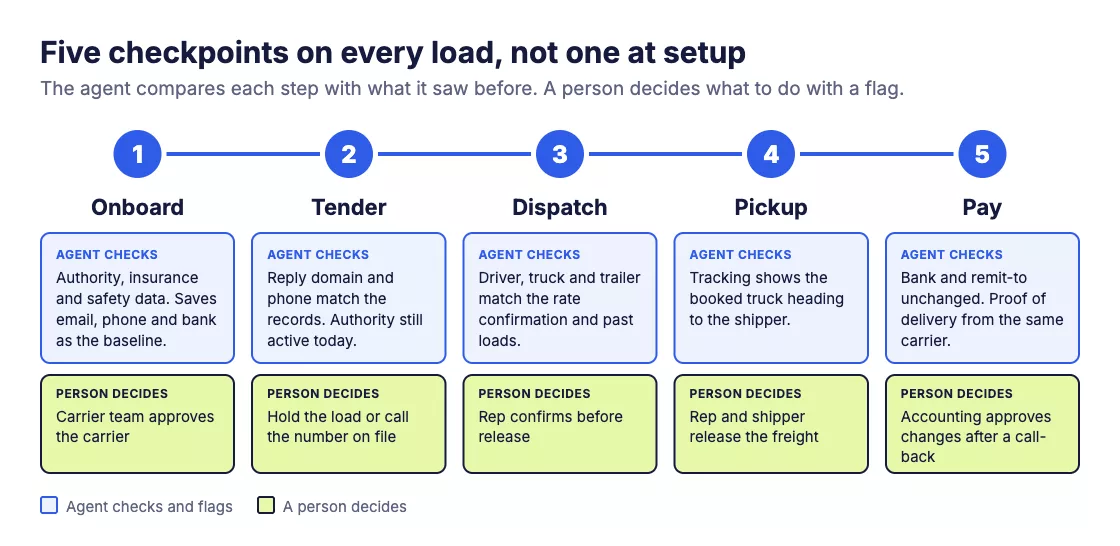
Five checkpoints where an agent re-checks the carrier
| Checkpoint | What the agent checks | Who decides |
|---|---|---|
| Onboard | Authority, insurance and safety data from your vetting tool and FMCSA records. Saves contact details as the baseline. | Your carrier team approves the carrier |
| Tender | The reply's email domain and phone match the carrier's records. Authority and insurance are still active today. | A rep holds the load or calls the number on file |
| Dispatch | Driver, truck and trailer details match the rate confirmation and earlier loads from this carrier. | A rep confirms before release |
| Pickup | Tracking shows the booked carrier's truck heading to the shipper. | The rep and shipper decide whether to release freight |
| Pay | Bank and remit-to details are unchanged since onboarding. Proof of delivery comes from the same carrier. | Accounting approves any change after a call-back |
Most of these checks are plain rules. The AI handles the messy part: reading an email thread, noticing that dispatch@abctrucking-llc.com isn't the abctrucking.com on file, and writing a short note on why it flagged the load. It's the same inbox work as AI order entry at distributors, where tenders arrive the way purchase orders do.
Vetting tools you already pay for, or a custom agent?
Vetting tools have moved past onboarding. Highway says its Carrier Identity product "replaces one-time onboarding with continuous verification throughout every freight transaction" (Highway, checked November 2026), and it lets McLeod PowerBroker users add carriers to the TMS in one click (Highway). Carrier Assure scores carriers from FMCSA data and says it helps brokers avoid carriers with indicators of double brokering (Carrier Assure, checked November 2026). Neither publishes prices on its homepage.
| Vetting tool | Custom agent | |
|---|---|---|
| What it checks | The carrier: identity, authority, insurance, history | The load: emails, dispatch, tracking, payment |
| Where it works | The vendor's portal and integrations | Your TMS, inbox and accounting |
| Rules | The vendor's settings | Your hold-and-call rules, by customer or commodity |
| Ownership | Subscription | You own the code |
They work together: the agent reads the tool's score as one input. FinTechs face the same split between buying identity checks and building the workflow around them, as our guide to KYC and KYB automation explains.
How Softpers builds a carrier-vetting agent
- Free 30-minute callYou walk us through how you vet carriers today and which TMS you run. We send an estimate within 24 hours.
- Fixed-price pilot, 1–2 weeksThe agent re-checks 90 days of loads and lists the ones it would have flagged. Your team reviews each flag, so you see how many were real.
- Connect and add guardrailsWe connect your systems, set which signals hold a load and who can release it, and demo progress every week.
- Launch and trainChecks run on every new load, with runbooks for your carrier and accounting teams.
- 30-day warrantyWe watch it closely and fix issues. Then it's fully yours.
| System | What the agent reads | How it connects |
|---|---|---|
| TMS (McLeod, Aljex, Revenova, Turvo) | Loads, carriers, rate confirmations | The TMS API or scheduled exports |
| Email inbox | Tender replies and dispatcher emails | Your email provider's API |
| Vetting tool | Identity status, scores, alerts | The vendor's API, where offered |
| Tracking | Truck location at pickup | Your tracking provider |
| Accounting | Bank and remit-to changes | Your accounting system |
Releasing a held load stays with your team, the same way banks keep a person on every fraud alert decision.
What a carrier-vetting agent costs
Softpers projects start from $3k. You see a first working version in 1–2 weeks during the fixed-price pilot, and a carrier-vetting agent for one brokerage typically goes live in 2–8 weeks, with a 30-day warranty (Softpers AI Agents, checked November 2026). Each extra system, such as a second TMS or a factoring portal, adds build time, so it shows up in the estimate.
Most checks are simple lookups with no AI cost. Reading an email thread and writing a flag note uses roughly 15,000 input tokens and 1,000 output tokens. At Claude Sonnet 5.5's $2 and $10 per million (Anthropic, checked November 2026), that's about 4 cents, or 12 cents a load at three AI checks.
Here's an illustrative example, not a client result. A brokerage covers 600 loads a month. Reps spend 8 minutes a load checking carriers by hand; with the agent, they spend 3 minutes reviewing its flags. That's 50 hours a month, about $1,384 at the $27.68 mean hourly wage for cargo and freight agents at freight arrangement companies (BLS, May 2025), or about $16,600 a year before benefits. AI usage adds about $72 a month. One stolen load at the 2026 average would cost far more.
Is a carrier-vetting agent right for you? 30 seconds
FAQs
Does it replace Highway or Carrier Assure?
No. It reads their scores and alerts as one input and adds checks on your own emails, loads, tracking and payments. If you don't use a vetting tool, it can check FMCSA records directly, but a dedicated tool usually sees more.
Will it block good carriers?
It doesn't block anyone. It holds a load and tells a rep why. In the pilot you see how many flags were real, and you tune the rules before anything goes live.
Are we liable if a carrier we vetted causes a crash?
Since the Supreme Court's May 2026 ruling in Montgomery v. Caribe Transport II, brokers can face state negligent-selection claims. The agent can't remove that risk, but it keeps a dated record of every check on every load. Ask your attorney what standard applies to you.
Which TMS does it work with?
Any TMS we can read through an API or regular exports, such as McLeod PowerBroker, Aljex, Revenova or Turvo. We confirm access during the free call.
How long until it's live?
You see a first working version in 1 to 2 weeks during the fixed-price pilot, and a carrier-vetting agent for one brokerage typically goes live in 2 to 8 weeks.
- Fewer Cargo Thefts, Bigger Losses: Average Theft Value Jumps 72 Percent Year to Date (Verisk CargoNet, November 2026)
- Supreme Court Decides Montgomery v. Caribe Transport II, LLC (Faegre Drinker, May 2026)
- Supreme Court ruling puts freight broker vetting practices in spotlight (Trucking Info, May 2026)
- Broker and Freight Forwarder Financial Responsibility Rule Overview and Compliance Requirements (FMCSA, updated April 2026)
- FMCSA registration modernization: what to know about the new Motus system (DAT, May 2026)
- Carrier Identity (Highway, checked November 2026)
- McLeod Software and Highway partner to bring carrier identity management to PowerBroker customers (Highway press release, checked November 2026)
- Carrier Assure (Carrier Assure, checked November 2026)
- Claude API pricing (Anthropic, checked November 2026)
- Occupational Employment and Wage Statistics: Freight Transportation Arrangement, May 2025 (U.S. Bureau of Labor Statistics, 2026)
- AI Agents service (Softpers, checked November 2026)

Haider AbbasSoftware Engineer of Softpers
Full-Stack Software Developer with 5+ years of experience building scalable web applications using Laravel, React.js, Next.js, Node.js, Python, and Django. Passionate about problem-solving, clean architecture, AI-powered solutions, and delivering high-quality software that drives business value.