- An AI agent can read a certificate request, check it against the policy and its endorsements, and prepare the ACORD 25 for a licensed person to review and sign.
- A certificate cannot add coverage: additional insured status, a waiver of subrogation and notice of cancellation must already be in the policy.
- Every request ends one of three ways: a certificate ready to sign, an endorsement request for the carrier, or a handoff to a person.
- Explaining coverage, agreeing to add it and signing stay with licensed staff, and state rules differ.
- A custom build starts from $3,000, with a first working version in 1–2 weeks during the fixed-price pilot and go-live typically in 2–8 weeks.
It's 4 p.m. on a Thursday. A general contractor emails your client's account manager: send a certificate naming us as additional insured, with a waiver of subrogation and 30 days' notice of cancellation, or your insured can't start work on Monday. Filling in the form takes two minutes. Finding out whether the policy supports all three requests takes much longer. This explainer shows which part of that work an agent can do, and where it has to stop.
Why certificate requests eat your service team's day
An article in Independent Agent magazine put it plainly in 2026: "Fulfilling COI requests can consume substantial staff time, often without direct revenue." The same article notes that a late certificate can hold up a client's project (Independent Agent magazine, 2026).
The work lands on small teams. Independent agencies average 9.9 staff (Big "I" Agency Universe Study, 2026). In the same study, 45% of agencies named finding and screening job candidates with strong potential, which put it at the top of their list of challenges (Insurance Journal, 2026).
We found no reliable figure for how many certificates an agency issues or how long each one takes. Count your own: tally every request for two weeks, and time ten of them from the email to the sent certificate.
The volume also follows your renewals. Every renewed policy means a new round of certificates for the same holders, which is one of the steps in our guide to renewal prep automation.
What a certificate can and cannot do
The form says so itself. The ACORD 25 states that it "confers no rights upon the certificate holder" and does not "amend, extend or alter the coverage afforded by the policies." It adds: "If the certificate holder is an ADDITIONAL INSURED, the policy(ies) must have ADDITIONAL INSURED provisions or be endorsed" (ACORD 25, hosted by NY DFS).
| The request asks for | What has to be true first |
|---|---|
| Proof of liability coverage | The policy is in force today |
| The holder named as additional insured | The policy has additional insured provisions or is endorsed, and the carrier has approved it |
| A waiver of subrogation | The form says certain policies may require an endorsement |
| 30 days' notice of cancellation to the holder | The policy provides it. The form promises only that notice "will be delivered in accordance with the policy provisions" |
| Special wording in the description box | The carrier has reviewed and approved it |
The first row causes the most trouble. Utica National, an E&O carrier, writes: "The most common reason we see claims related to COIs is their issuance when coverage is not in force." It also traces many certificate errors to inaccurate information in the agency management system (Utica National, checked November 2026).
Wisconsin's insurance regulator takes the same view. Its 2008 bulletin calls certificate language that amends or extends coverage, or that states coverage is in force when it is not, a misrepresentation that can lead to license suspension or revocation (Wisconsin OCI, 2008). The bulletin is old and covers one state, so check your own state's rules.
How an AI agent handles a certificate request
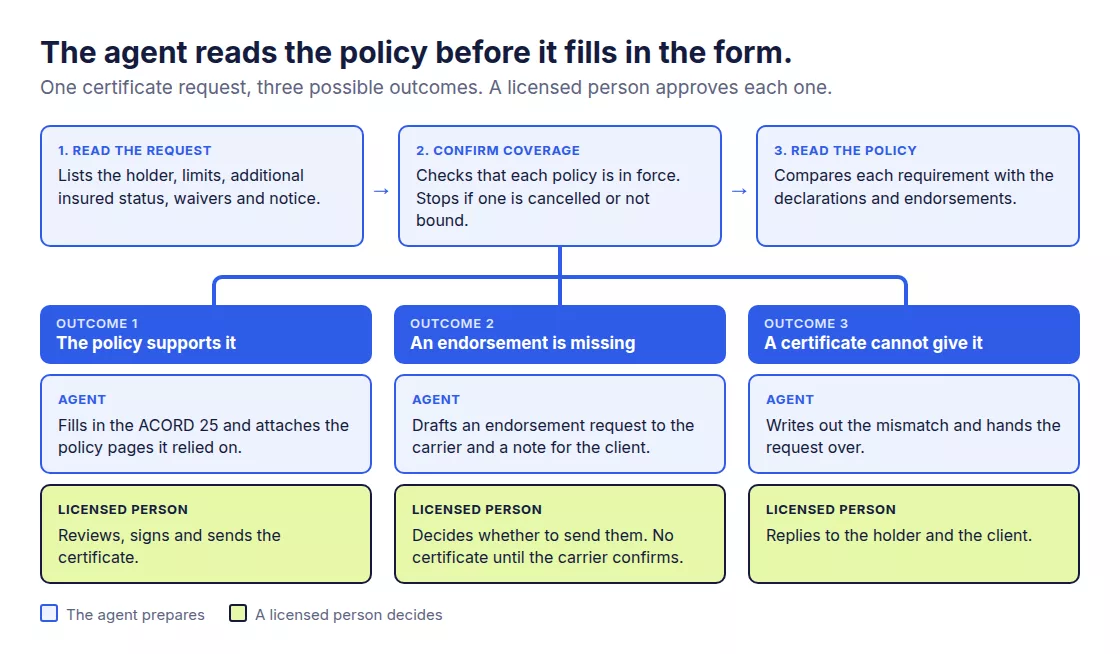
- Read the requestThe agent reads the email and any attached contract. It lists each requirement: the holder's name and address, the limits, additional insured status, waivers and notice.
- Confirm coverage is in forceIt finds the insured in your management system and checks each policy. If a policy was cancelled or the renewal is not bound, it stops and tells the account manager.
- Read the policy and its endorsementsIt compares each requirement with the declarations and the endorsement forms. It does not copy last year's certificate.
- Outcome 1: the policy supports the requestThe agent fills in the ACORD 25 from the policy record and attaches the pages it relied on. A licensed person reviews, signs and sends it.
- Outcome 2: an endorsement is missingThe agent drafts an endorsement request to the carrier and a note for the client. The account manager decides whether to send them. No certificate goes out until the carrier confirms.
- Outcome 3: a certificate cannot give itSpecial wording or a promise the policy does not make goes to the account manager, with the mismatch written out.
- Log every stepThe request, the pages checked, the approver and the sent certificate are saved as an activity in your management system.
Utica National advises agencies to "have a two-person review process to confirm the information is accurate before the COIs are released," and warns: "Do not just duplicate a prior-year COI" (Utica National, checked November 2026). The agent does not replace that review. It makes the review faster, because each requirement sits beside the policy page that supports it.
What needs a licensed person
NAIC guidelines from 2000 list "preparing for an insurance producer's review and signature all binders, certificates, endorsements, identification cards or policies" among the clerical acts that do not need a license. For issuing a certificate, the same guidelines say it depends on whether issuance is "physical delivery only" or the effectuation of the policy. The NAIC calls the guidelines informational, and each state writes its own rules, so check with your state's insurance department (NAIC licensable activities guidelines).
| Task | AI agent | Licensed person |
|---|---|---|
| Read the request and list what it asks for | Yes | |
| Check that coverage is in force and find the endorsements | Yes | Reviews |
| Fill in the ACORD 25 | Prepares | Reviews and signs |
| Draft an endorsement request to the carrier | Prepares | Decides and sends |
| Tell a holder or client what the coverage means | No | Yes |
| Say that coverage will be added or is bound | No | Yes |
Where AI should stay out. Four things should never be automated:
- Changing the printed wording of the form, or adding special wording the carrier has not approved.
- Showing an additional insured the carrier has not approved.
- Answering a holder who asks whether a claim would be covered.
- Sending a certificate that nobody at the agency has looked at.
Mortgage brokers draw a similar line, as we explain in what an AI loan officer assistant can say without a license.
This is general information, not legal advice; licensing rules vary by state.
Certificate software or a custom agent?
| Option | What its own page says | Published price |
|---|---|---|
| Vertafore AgencyOne Certificates | Announced in April 2026 as "a fully integrated Certificates of Insurance (COI) solution within AgencyOne." It uses data from the management system, and clients can generate certificates through InsurLink at any hour. Available to AgencyOne customers with AMS360 and InsurLink (Vertafore, 2026) | None in the announcement |
| Certificate Hero | "A SaaS platform which allows insurance brokers and their clients to efficiently and accurately issue and manage Certificates of Insurance" (Certificate Hero) | By quote (checked November 2026) |
| Certificial | Issues certificates and reissues them when policies update, with a plugin for Applied Epic and CSR24 users (Certificial) | $0 for agents and brokers (Certificial pricing, checked November 2026) |
| A custom agent | Your own certificate procedure, across your inbox, your management system and the policy documents | From $3,000 |
If most of your requests are standard certificates for holders already on file, a packaged tool will probably fit better than a custom build. Ask each vendor three questions: does it check the endorsements or only the management system record, where does a licensed person approve the certificate, and which management systems does it connect to.
A custom agent makes sense when the request is a paragraph in an email or ten pages of contract insurance requirements. That is the same email-to-system problem distributors have with purchase orders, which we covered in AI order entry for distributors.
How Softpers builds a certificate agent
- Free 30-minute callYou show us five recent requests: two easy ones and three that needed a call to the carrier. You get an estimate within 24 hours.
- Fixed-price pilot, 1–2 weeksWe replay last month's requests. The agent sorts each one into the three outcomes, and you compare its answer with what your team sent.
- Connect and add guardrailsNo certificate leaves without a person's approval. The agent never answers a coverage question, and it logs each action in your management system.
- Launch and trainYour account managers learn to review the agent's reading of the policy, correct it and approve the certificate.
- 30-day warrantyWe watch the first month of requests and fix what comes up, and you own the code.
| System | What the agent reads | How it connects |
|---|---|---|
| Applied Epic | Policies, certificate holders, activities | Applied's SDK. Applied says integrations need an SDK-API License and a utility license (Applied Systems) |
| AMS360 | Policies, certificate holders, activities | Web Service API. Your agency authorizes vendor access in setup (Vertafore help) |
| HawkSoft | Clients and policies; writes activities back as log notes | Partner API. HawkSoft issues the credentials (HawkSoft) |
| Certificate requests and contract attachments | A shared certificates mailbox | |
| Policy documents | Declarations and endorsement forms | The PDFs attached in your management system, or files your team downloads from the carrier |
What we can connect depends on your system and your license with its vendor. We confirm that on the first call.
What certificate automation costs
| Item | Cost | Source |
|---|---|---|
| Custom build | From $3,000, with a fixed-price pilot and a 30-day warranty | Softpers AI agents |
| AI usage | About $0.15 per request | Claude Sonnet 5.5 at $2 per million input tokens and $10 per million output tokens (Anthropic, checked November 2026), for 60,000 input and 3,000 output tokens |
| Staff time today | $23.64 an hour, before benefits | Mean wage for customer service representatives at insurance agencies and brokerages, May 2025 (BLS) |
| Packaged tools | $0 to a custom quote | Vendor pages, checked November 2026 |
Here is the math for one agency. It is an illustrative example, not a client result.
- 300 certificate requests a month, at 12 minutes each. Both numbers are assumptions, so use your own two-week count.
- The agent does the reading and the form. A person still spends 4 minutes on review and signature, so 8 minutes are saved per request.
- 300 × 8 minutes = 40 hours a month.
- 40 hours × $23.64 = about $946 a month.
- AI usage: 300 × $0.15 = $45 a month.
- Net saving: about $901 a month, or about $10,800 a year.
- Payback on a $3,000 build: a little over three months.
The wage is conservative. Licensed staff cost more: insurance sales agents in the same industry average $38.58 an hour (BLS, May 2025). The example also leaves out the cost of one wrong certificate, which is harder to price.
Would a certificate agent help your agency? 30 seconds
FAQs
Can AI issue a certificate of insurance without a person?
It should not. The agent can prepare the ACORD 25 and show the policy pages it relied on, but a licensed person reviews and signs it. NAIC guidelines list preparing a certificate for a producer's review and signature as clerical work, and say that issuing one depends on what the issuance does. State rules differ, so check with your state's insurance department.
What happens when a request asks for additional insured status the policy does not have?
The agent does not tick the box. It drafts an endorsement request to the carrier and a note for the client, and the account manager decides whether to send them. No certificate goes out until the carrier confirms the endorsement.
Does this work with Applied Epic, AMS360 or HawkSoft?
Each has a route for outside software, but access depends on your system and your license with its vendor. Applied says integrations need an SDK-API License and a utility license, AMS360 has a Web Service API your agency authorizes, and HawkSoft issues Partner API credentials. We confirm what is possible on the first call.
How much does certificate of insurance automation cost?
A custom build starts from $3,000, with a fixed-price pilot and a 30-day warranty. AI usage is about $0.15 per request in our example. You see a first working version in 1–2 weeks during the pilot, and an agent for one agency's certificate requests typically goes live in 2–8 weeks.
Should we buy certificate software or build a custom agent?
Start with the tool your management system vendor offers, especially if most requests are standard certificates for holders already on file. A custom agent makes sense when requests arrive as emails and contracts that someone still has to read against the policy and its endorsements.
- ACORD 25 Certificate of Liability Insurance (ACORD, hosted by NY DFS, 2025)
- 8 Tips for Handling Certificates of Insurance for Your Clients While Protecting Your Agency (Utica National E&O Program, checked November 2026)
- Issues Regarding the Use of Property and Casualty Certificates of Insurance (Wisconsin Office of the Commissioner of Insurance, 2008)
- Licensable activities guidelines (NAIC, 2000)
- Magic in a Bottle: Challenges and Opportunities with Certificates of Insurance (Independent Agent magazine, 2026)
- Big "I" and Future One Release 2026 Agency Universe Study (Big "I", 2026)
- 2026 Agency Universe Study coverage (Insurance Journal, 2026)
- Vertafore unveils integrated Certificates solution (Vertafore, 2026)
- Certificate Hero and Certificial product and pricing pages (checked November 2026)
- Applied Epic API integration (Applied Systems)
- AMS360 Web Service API setup (Vertafore)
- HawkSoft Partner API 3.0 (HawkSoft)
- Occupational Employment and Wage Statistics, Insurance Agencies and Brokerages (BLS, May 2025)
- Claude API pricing (Anthropic, checked November 2026)

Hassan AbbasAI Automation Engineer of Softpers
Hassan builds AI agents and workflow automation for insurance agencies and accounting firms. He writes about where AI fits in renewals, certificates and back-office work, and where a licensed person has to stay in control.