- The SAFE Act defines a loan originator as "an individual," so software can't hold an NMLS license. The question is what the AI says, not whether it is licensed.
- Presenting terms picked for one borrower, or answering "can you do better on the rate?", is loan originator activity under Regulation H and Regulation Z.
- General explanations, the steps to get an offer, arranging closing and "your offer has been sent" are not.
- Federal rules require a named loan officer and NMLS ID on the application, Loan Estimate, Closing Disclosure, note and security instrument.
- The Mortgage Bankers Association's June 2026 white paper recommends keeping a licensed loan officer in the loop even when AI does much of the work.
This post explains federal rules for mortgage brokers. It is not legal advice. State licensing laws add their own requirements, so check yours with counsel.
Why the license question is about the task, not the software
The SAFE Act defines a loan originator as an individual who "takes a residential mortgage loan application" and "offers or negotiates terms of a residential mortgage loan for compensation or gain" (12 U.S.C. 5102). The same section excludes anyone doing "purely administrative or clerical tasks" for a loan originator. It defines those tasks as collecting and passing along information "common for the processing or underwriting of a loan" and contacting a consumer "to obtain information necessary" for that work.
Regulation Z draws the same line for its loan originator rules. It excludes a person who does not take applications or offer terms "but who performs purely administrative or clerical tasks on behalf of a person who does engage in such activities" (12 CFR 1026.36(a)).
Software can't hold a license. A June 2026 white paper prepared for the Mortgage Bankers Association by the law firm Orrick says the SAFE Act "does not require AI tools to have their own MLO license or registration." As HousingWire notes, the act also doesn't say whether a mortgage company can run a loan with no human involved at all (HousingWire, June 2026).
What counts as offering or negotiating terms
Regulation H, which applies the SAFE Act to state-licensed loan officers, lists examples (Appendix A to Part 1008). Offering or negotiating includes:
- "Presenting for consideration by a borrower or prospective borrower particular loan terms", even when the offer is conditional or the person lacks authority to set the rate.
- Communicating with a borrower to reach an understanding about loan terms, including presenting a new offer when the borrower asks for a different rate or fees, even if they never agree.
The Regulation Z commentary says the same about "presenting particular credit terms for the consumer's consideration that are selected based on" the consumer's finances (comment 36(a)-1).
Watch the application trap too. Under Appendix A, a person who only types a borrower's information into an online application or other automated system can still be taking an application. So an AI intake flow should collect facts for the loan officer, and the loan officer reviews and owns the application.
What an AI assistant can do
The same rules list work that is not offering or negotiating (Reg H Appendix A (b)(2); Reg Z comment 36(a)-4):
- "Providing general explanations or descriptions in response to consumer queries", such as what debt-to-income means.
- "Explaining or describing the steps that a borrower or prospective borrower would need to take" to get a loan offer.
- Arranging the closing and other parts of the loan process. Any mention of loan terms may only confirm terms the borrower already agreed to.
- Telling a borrower that a written offer has been sent, without giving its details.
- Compiling application packages and supporting documents.
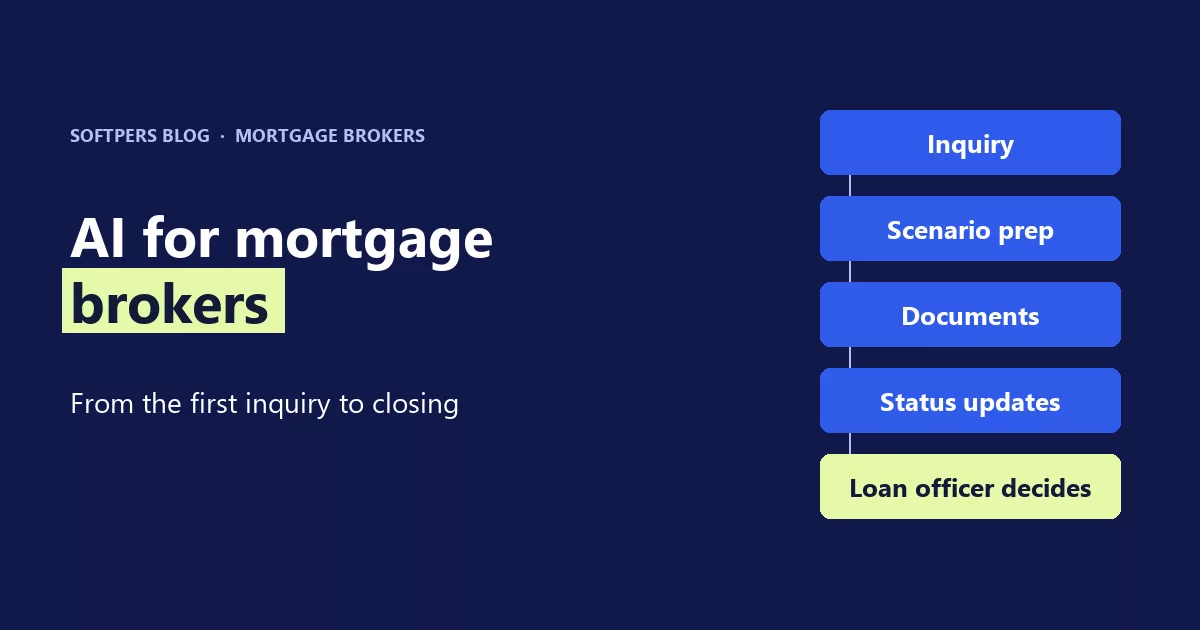
For how this works across a whole file, from first inquiry to closing, see AI for Mortgage Brokers.
Borrower messages: AI or loan officer?
| Borrower says | Who answers | Why |
|---|---|---|
| "What does debt-to-income mean?" | AI | General explanation (Reg H App. A (b)(2)(i)) |
| "What do I need to get pre-approved?" | AI | Steps to obtain an offer (App. A (b)(2)(v)) |
| "Can you send me the upload link for my pay stubs?" | AI | Collecting information for processing (12 U.S.C. 5102(4)(C)) |
| "When is my closing, and is the title company booked?" | AI | Arranging the loan process (App. A (b)(2)(ii)) |
| "Did my Loan Estimate go out?" | AI, no figures | Saying an offer was sent, without its details (App. A (b)(2)(vi)) |
| "What's today's rate?" | AI links your published rate page | Not terms picked for this borrower (App. A (b)(1)(i)). Any rate it states must also be shown as an APR (12 CFR 1026.24(c)) |
| "With a 680 score and 10% down, what rate would I get?" | Loan officer | Terms picked for this borrower (App. A (b)(1)(i)) |
| "Another broker offered 6.25%. Can you match it?" | Loan officer | Request for a different rate or fees (App. A (b)(1)(ii)) |
| "Should I lock now or wait?" | Loan officer | Discussing particular credit terms (comment 36(a)-4.ii) |
A hand-off line the agent can use:
That's a question for your loan officer, [Name] (NMLS #[ID]). I've sent them your details, and they can call you today at 2 pm or 4 pm. Which works?
Sample hand-off messageWhy a human still has to own the file
Regulation Z requires the loan originator organization's name and NMLS ID, plus "the name of the individual loan originator (as the name appears in the NMLSR) with primary responsibility for the origination", on the credit application, the Loan Estimate and Closing Disclosure, the note and the security instrument (12 CFR 1026.36(g)).
According to HousingWire, the MBA white paper treats this as an effective requirement to assign a human loan officer. It also warns that lenders could face risk under federal and state consumer protection laws if borrowers believe a human loan officer is overseeing their application when AI is handling all of it (HousingWire).
The CFPB made the broader point in 2023: chatbots "must comply with all applicable federal consumer financial laws," and companies "may be liable for violating those laws when they fail to do so" (CFPB issue spotlight, June 2023). The same report found that about 37% of the US population used a bank's chatbot in 2022. The principle applies just as much to a broker's agent.
What it costs
Loan officers at non-bank lenders, including mortgage lenders (the BLS "nondepository credit intermediation" industry), earn a mean $38.26 an hour, or $79,580 a year (BLS OEWS, May 2025). BLS doesn't publish a separate figure for loan officers at mortgage brokers. Commission-paid loan officers lose more than their wage, because those hours come out of selling time.
A worked example for one loan officer. The hours and running costs are assumptions, so swap in your own:
| Line | Amount |
|---|---|
| Hours a week on status and document questions (assumed) | 5 |
| Cost at $38.26 an hour | $191 a week, about $829 a month |
| Assistant running costs: AI model usage, messaging and hosting (assumed) | $200 a month |
| Net saving | About $629 a month |
| Payback on a $3k build | About 5 months |
With three loan officers at the same 5 hours, their time costs about $2,487 a month, and the build pays back in under 2 months. Running costs rise with message volume, so ask for them in any quote.
At Softpers, custom AI agents start from $3k with a fixed-price first phase. You see a working first version in 1–2 weeks, and most agents go live in 4–8 weeks, depending on how many tools they connect to (Softpers AI agents).
How Softpers builds a compliant assistant
Every borrower message goes through the same path:
- A borrower sends a messageBy text, WhatsApp, web chat or email.
- The agent checks the hand-off rulesIs this a general or process question, or does the answer depend on this borrower's credit, income or loan amount?
- Clerical question: the agent drafts a replyA person approves it before it goes out, and the exchange is logged.
- Terms question: the loan officer takes overThe agent passes on the borrower's details and offers call times. It never quotes a rate.
The rules we use on mortgage projects:
- The AI may monitor, summarize, compare, draft and escalate.
- The AI never picks a loan, rate or price, declines a borrower, or sends regulated disclosures.
- A person approves every outside message until a workflow has earned more autonomy.
- Every step is logged: what came in, what the AI drafted, who approved it, what they changed and when it was sent.
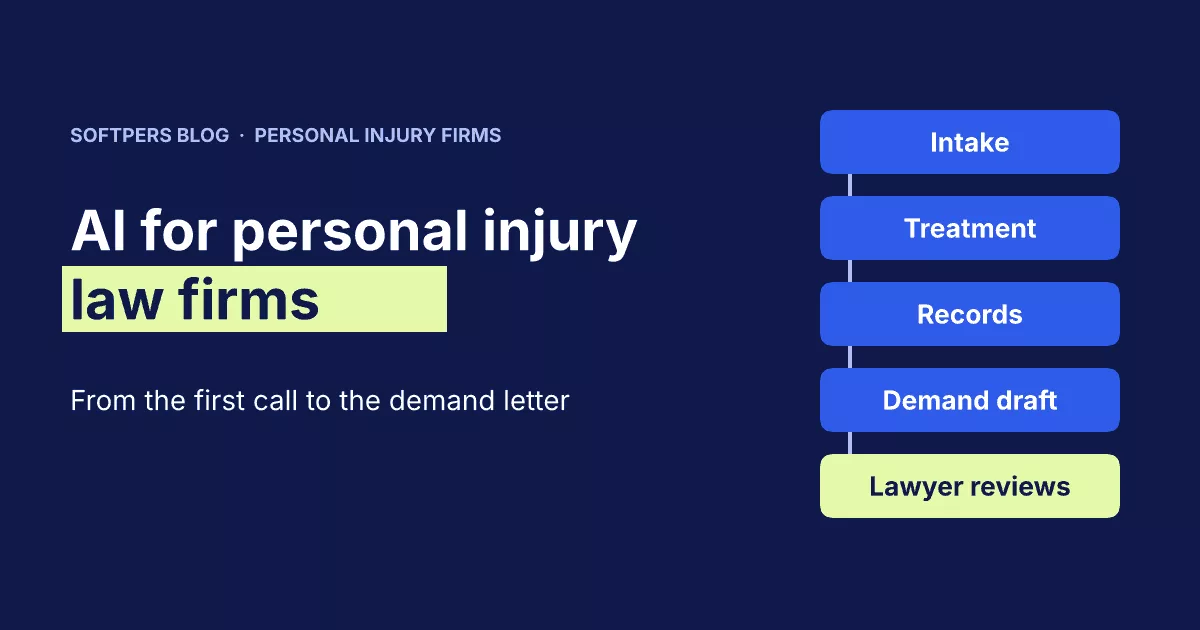
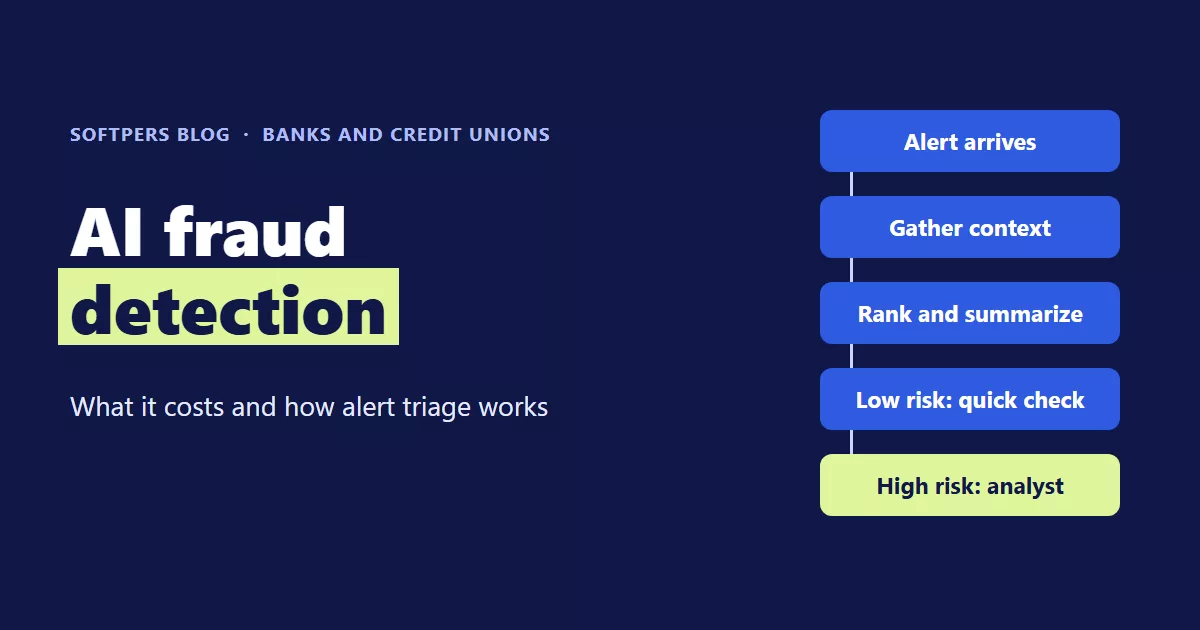
It's the same split we use in other regulated work: AI handles intake for personal injury firms but never gives legal advice, and it triages bank and credit union fraud alerts but never files a SAR on its own.
Each project includes a 30-day warranty. You own the code, prompts and accounts, your data stays in your accounts, and models are never trained on it.
Is an AI assistant a fit for your brokerage? 30 seconds
FAQs
Does an AI mortgage assistant need an NMLS license?
No. The SAFE Act licenses individuals, and the MBA's June 2026 white paper says the act "does not require AI tools to have their own MLO license or registration." The licensed loan officer who owns the file is responsible for what the assistant says.
Can an AI chatbot tell a borrower today's mortgage rates?
It can point to rates you publish for everyone, and any rate it states must also be shown as an APR. It should not quote a rate based on that borrower's credit score, down payment or loan amount. That is presenting particular terms, which is loan originator work.
Can AI replace loan officers?
Not in practice. No federal rule says a human must take part in every step, but Regulation Z requires a named loan officer with an NMLS ID on the application, disclosures, note and security instrument. The MBA reads that as an effective requirement to assign a human. AI takes over the clerical work around them.
- 12 U.S.C. 5102, SAFE Act definitions (Cornell LII)
- 12 CFR 1026.36, Regulation Z loan originator rules (CFPB)
- Official interpretation of 12 CFR 1026.36 (CFPB)
- 12 CFR 1026.24, Regulation Z advertising (CFPB)
- Appendix A to 12 CFR Part 1008, examples of loan originator activities (CFPB)
- MBA white paper urges unified AI framework for mortgage lenders (HousingWire, 2026)
- Examining AI-Powered Mortgage Through the Lens of Federal Law (MBA, 2026)
- Chatbots in consumer finance (CFPB, 2023)
- OEWS: Loan Officers in Nondepository Credit Intermediation (BLS, May 2025)
- AI agents service (Softpers)