- Finding homes is largely solved: in NAR's 2025 Profile, 52% of buyers found their home online and 70% used a phone or tablet during the search.
- The bigger loss is after the offer: Redfin reported 14% of home-purchase agreements fell through in July 2026, the highest share in nearly three years.
- The work between contract and closing is deadline tracking, document chasing and updates for five to seven parties, which is exactly what AI agents are good at.
- Money movement, wire instructions, contract language and pricing advice must stay with licensed people; real estate fraud losses reached $275.1 million in 2025.
- Softpers builds closing-focused AI agents from $3,000, starting with a 1–2 week fixed-price pilot and going live in 2–8 weeks.
Most real estate AI you've seen is about the front of the funnel: smarter search, listing descriptions, chatbots that answer at 9 p.m. Those tools are useful, and most brokerages now have some version of them. But a lead that turns into a signed contract isn't revenue yet. Revenue arrives at the closing table, and the stretch between those two points is still run on email threads, spreadsheets and someone's memory.
Finding homes is a solved problem
In NAR's 2025 Profile of Home Buyers and Sellers, 52% of buyers found the home they bought online and 70% used a phone or tablet during the search. Portals, MLS search and listing alerts already do the finding.
That doesn't make agents less important. The same report found 88% of buyers still bought through an agent. What it means is that the part of the job software already handles well is the search. The part it barely touches is everything after "we have a deal."
So when a vendor pitches AI that "finds the perfect home," ask what it adds to what your buyers already do on Zillow at midnight. Usually the honest answer is: not much.
Where deals actually die
of U.S. home-purchase agreements that went under contract in July 2026 fell through.
The highest share in nearly three years, according to Redfin's analysis of MLS pending-sales data.Redfin has reported cancellation rates between roughly 13% and 16% all year, with some metros, such as Atlanta and San Antonio, near 1 in 5. NAR's own survey of agents shows a lower figure, around 6% of contracts terminated over three months, because it measures differently. Either way, deals that were already won are being lost.
The reasons are familiar. Redfin agents point to post-inspection repair costs and appraisals. Add financing that slips, a missed contingency deadline, a buyer who goes quiet for four days, and a seller who hears nothing and assumes the worst.
Some of that can't be prevented: a buyer who loses their job is going to walk. But a lot of it is coordination failure. Something was due, nobody chased it, and by the time anyone noticed, the buyer had cold feet or the deadline had passed.
Why closing is the harder AI problem
A typical purchase involves the buyer, the seller, two agents, a lender, an appraiser, an inspector and a title or escrow company, sometimes an attorney too. ICE's Mortgage Monitor shows the average purchase loan took 36.8 days to close in March 2026: about 11 days from application to rate lock, then 26 more to closing. Every one of those days has someone waiting on someone else.
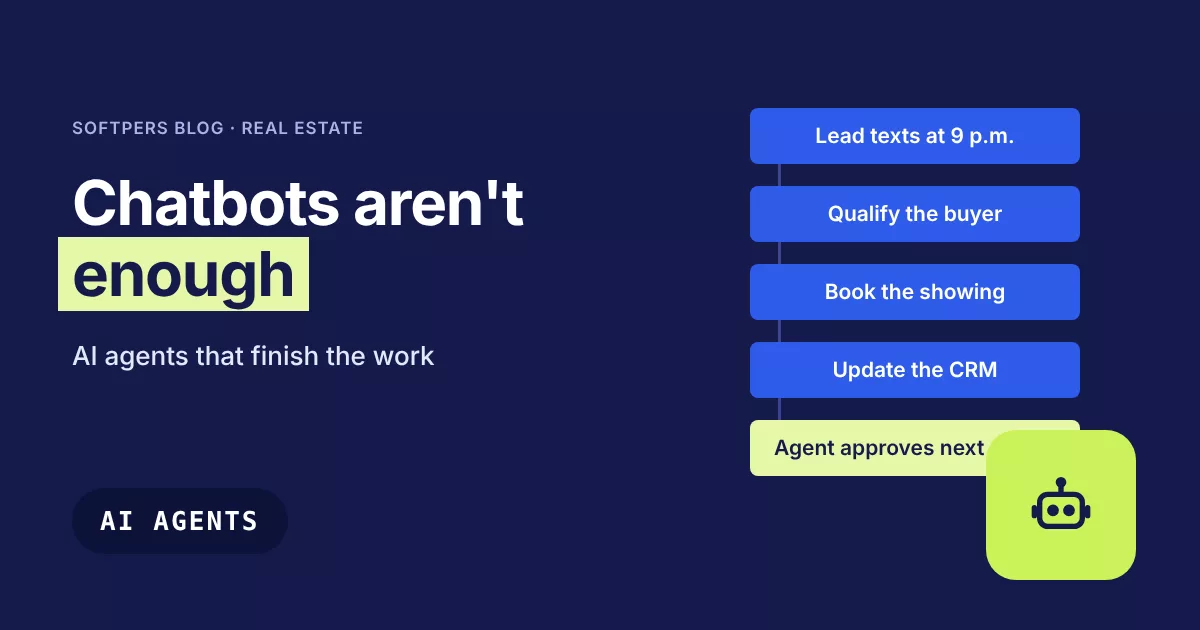
A chatbot can't run that. It answers when asked. Closing needs software that acts without being asked: it notices the appraisal isn't scheduled, texts the lender, updates the buyer and tells the agent before it becomes a problem. That is what an AI agent does, as we explained in our piece on why chatbots aren't enough.
It is also why the next wave of investment will go here. The search problem has been funded for 20 years. The coordination problem is where the hours, and the lost commissions, still are.
What closing-focused AI does, stage by stage
| Stage | What usually happens | What an AI agent does |
|---|---|---|
| Contract signed | Coordinator reads the contract and types dates into a spreadsheet | Reads the contract, builds the deadline calendar and sends a timeline to every party |
| Inspection | Agent remembers to book it, or doesn't | Books the inspector, confirms access with the listing side, flags the report the moment it arrives |
| Appraisal and financing | Agent calls the lender when the buyer asks for an update | Checks status with the lender on a schedule, chases missing buyer documents, alerts the agent if the appraisal date isn't set |
| Contingency deadlines | Someone notices on the day | Warns the agent several days ahead and drafts the extension request for a person to approve |
| Closing | A flurry of last-minute emails | Confirms the closing time, documents and walkthrough, and reminds buyers to verify wire details by phone with title |
Here's a simple way to size it. Take a brokerage with 300 deals under contract a year. At a 14% cancellation rate, about 42 fall through. Suppose better coordination saves just five of them, and say your average gross commission per side is $8,000. That's $40,000 a year from deals you had already won. Use your own numbers; the point is that the return comes from revenue you've already paid to acquire.
What must stay with people
Closing is where the money moves, so it's also where the fraud is. The FBI's Internet Crime Complaint Center recorded 12,368 real estate fraud complaints in 2025, with $275.1 million in reported losses, up from about $173 million in 2024. Business email compromise, which often targets closings and wire transfers, accounted for about $3 billion more in reported losses across all industries.
So the rules are strict:
- Never touch wiring instructions. The agent doesn't send, change or confirm them. It tells buyers to verify by phone with the title company, using a number they already have.
- No contract changes on its own. It can draft an extension or a repair addendum; a person reviews and sends it.
- No pricing or legal advice. It passes those questions to the agent.
- Its own identity. Its own number, inbox and system accounts, with every action logged, so you can audit it and switch it off.
These limits aren't a weakness. They are what makes a brokerage willing to trust the agent with everything else.
How to start
- Map one real dealTake a recent closing and list every message, date and document from signed contract to keys. That list is the agent's job description.
- Mark the approval pointsAnything involving money, contract terms or advice gets a human yes before it goes out.
- Connect the systemsYour CRM, transaction management platform, calendar, email and text. The agent needs to write to them, not just read them.
- Run in shadow modeFor two to four weeks, the agent drafts every message and update and a coordinator approves and sends. Fix what it gets wrong.
- Measure closings, not messagesTrack missed deadlines, days to close, cancellation rate and files per coordinator.
What it costs
| What you get | Time and cost | |
|---|---|---|
| Pilot | Your under-contract workflow mapped and running in shadow mode on real data | 1–2 weeks, fixed price |
| Production agent | Connected to your CRM, transaction platform, calendar, email and text, with approval steps and full logging | From $3,000; live in 2–8 weeks |
| Running costs | AI model usage and hosting | Grows with deal volume; we estimate it before the build |
The honest limits: an agent is only as good as the data and systems it connects to. If your dates live in someone's head and your documents live in personal inboxes, the first job is getting them into one place. And it won't save a deal the buyer wants to walk away from. What it will do is stop you losing deals because something was due and nobody chased it.
FAQs
Why focus AI on closing instead of lead generation?
Because finding homes is already well served by portals, MLS search and chatbots, while a meaningful share of deals still fail after contract. Redfin reported 14% of home-purchase agreements fell through in July 2026. Every deal saved after contract is a commission already earned, with no new marketing spend.
What does a closing-focused AI agent actually do?
It reads the signed contract, builds the deadline calendar, chases inspectors, appraisers, lenders and title for documents and dates, sends status updates to buyers and sellers, logs everything in the CRM and alerts the agent when something is at risk. A person approves anything involving money, contract changes or advice.
Will an AI agent replace our transaction coordinator?
No. It takes the chasing and data entry off the coordinator's plate so one person can handle more files and spend their time on the problems that actually need judgment, such as a renegotiation after inspection or a financing issue.
Is it safe to let AI handle closing communications?
Only with clear limits. The agent should never send, change or confirm wiring instructions, never change contract terms and never give pricing or legal advice. It should run from its own number and inbox, log every action, and start in shadow mode where a person approves each message.
What does it cost to build?
Softpers AI agent projects start from $3,000. Each begins with a 1–2 week fixed-price pilot on one workflow, such as under-contract-to-close, and most agents go live in 2–8 weeks depending on how many systems they connect to. Model usage and hosting costs depend on volume and are estimated before the build.
- With Buyers Firmly in the Driver's Seat, Home-Purchase Cancellations Hit Highest Level in Nearly 3 Years (Redfin, August 21, 2026)
- Home Purchase Cancellations Are No Longer on the Rise As Demand Ticks Up (Redfin, May 21, 2026)
- February 2026 REALTORS® Confidence Index Survey (National Association of REALTORS®, March 2026)
- NAR 2025 Profile of Home Buyers and Sellers Reveals Market Extremes (National Association of REALTORS®, November 2025)
- 2025 NAR Profile of Home Buyers and Sellers (National Association of REALTORS®, November 2025)
- ICE Mortgage Monitor: Home Prices Post Strongest Monthly Gain in Nearly Two Years (MBA NewsLink, May 2026)
- Latest FBI Cybercrime Report Shows Real Estate Fraud Losses Rising (American Land Title Association, April 2026)
- 2025 Internet Crime Report (FBI Internet Crime Complaint Center, April 2026)
- How fraud gets stopped in its tracks by real estate and title pros (HousingWire, 2026)